
It’s official, Connected TV has won the living room.
As of May 2025, streaming reached a historic milestone: for the first time ever, it commanded 44.8% of all TV viewing, surpassing broadcast (20.1%) and cable (24.1%) combined.1
Yet there’s a disconnect: in 2026, adults in the U.S. will spend about 20% of their daily media time with CTV, yet CTV only captures 8.1% of total ad spend, showing that time spent is growing faster than budgets.2
For tactical agency teams managing app clients—especially those with strict CPI and ROAS targets—CTV represents massive untapped scale. But there’s a reason budgets have stayed on the sidelines. In surveys, 75% of CTV advertisers admit to feeling “confused” by attribution methods,3 and 32% of media executives rate CTV as “not very effective” despite rising spend.4
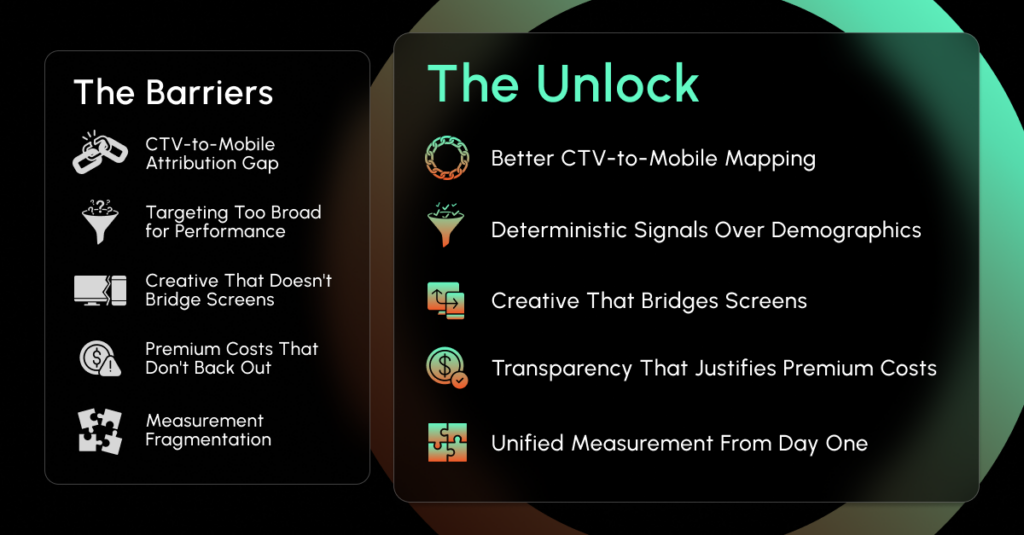
Through our work with mobile performance advertisers who are trying to reach audiences on TV, we’ve identified five consistent barriers that keep CTV budgets on the sidelines. These include attribution gaps and creative challenges that make it difficult to justify spend against strict performance goals. We spoke with agency leaders managing app campaigns to confirm what we’re seeing in the market.
Here’s what’s holding mobile performance budgets back, why these barriers matter, and how the CTV-to-mobile landscape is finally shifting to solve them in 2026.
The Five Barriers Keeping Mobile Performance Budgets out of CTV
Barrier #1: The CTV-to-Mobile Attribution Gap
Measurement and attribution is the #1 challenge for U.S. CTV advertisers.3 Unlike mobile, where Mobile Measurement Partners (MMPs) provide user-level tracking, CTV relies on household-level estimates, probabilistic matching, and the “halo effect.”5 IP-based fingerprinting—the most common workaround—has an estimated match rate below 70%.6 What’s more, cross-device attribution remains fundamentally fragmented: viewers switch between TV, mobile, and tablet with no unified tracking to connect the dots.
When asked to identify their single biggest attribution challenge, 30% of advertisers cited “lack of access to CTV-specific methodologies.”3 Without user-level proof that a CTV impression drove a mobile install, agencies simply can’t justify spend to performance-focused app clients.
Skyler McGill, Head of Programmatic & Video at Wpromote, weighed in on the need for a new measurement model that considers the incremental impact on your broader strategy:
“CTV can be a full funnel channel, but it requires a different measurement playbook. It will not deliver last-click attribution like paid search or social, but when measured through incrementality testing, brand lift studies, and media mix modeling, it consistently lowers customer acquisition costs and improves conversion efficiency across your entire funnel. Expect 8-12 week evaluation windows minimum. Measure it as part of your total marketing ecosystem, not in isolation, and you will see meaningful lift from awareness through conversion. The brands winning with CTV have evolved beyond last-click metrics to understand true incremental impact.”
The Unlock:
Better CTV-to-mobile matching fueled by first-party data. While MMPs still control attribution, improved TV-to-mobile signal mapping can drive more accurate tracking of the customer journey from big screen exposure to mobile app install.
Barrier #2: Targeting That’s Too Broad for Performance Standards
Despite prioritizing brand awareness as their top objective, 80% of marketers still rely on audience-based targeting tactics rather than content-based strategies.4 While specific audiences absolutely exist on CTV—for example, two-thirds of CTV users are active gamers10—targeting them deterministically based on actual behavior has been nearly impossible. Most CTV buying relies on broad demographic segments or contextual categories, not the behavioral signals that drive performance on mobile.
Agustin Ochoa, Director of Paid Media at Winclap, agreed that until CTV reliably delivers stronger signals, it would be underutilized as an app growth performance channel.
“Most CTV targeting today is still optimized for reach, not results. For performance-driven advertisers, the real limitation isn’t reach or inventory, but how disconnected targeting remains from a performance mindset. The challenge is translating intent, signals, and learnings from mobile into the living room. Until CTV targeting can reliably leverage stronger signals, close the loop with mobile outcomes, and improve traceability between exposure and conversion, it will remain underutilized as a performance channel and fail to become a scalable driver of app growth.”
The Unlock:
Deterministic targeting that predicts performance not just demographics. This means audiences built from actual viewing and gameplay behavior combined with ML-driven propensity modeling that identifies likelihood to install and engage on mobile devices, and cross-device identity resolution that closes the loop between TV exposure and mobile conversion.
Barrier #3: Creative That Doesn’t Bridge Screens
Traditional 30-second brand spots don’t effectively showcase an app’s value proposition. There’s no clear call-to-action path from a 75-inch TV to a 6-inch mobile screen. Creative optimized for TV awareness rarely includes app-first messaging like UI previews, gameplay clips, or specific feature callouts that drive install intent.
Carla Vassalo, Team Leader of User Acquisition, UGC & Organic Growth at Addict Mobile, echoed that without a clickable CTA, the conversion path from CTV-to-mobile doesn’t really exist.
“CTV creative for app campaigns plays by very different rules than mobile. Ads are shown on a large screen, in a premium environment, which raises expectations in terms of production quality and storytelling and often comes with higher costs. At the same time, CTV sits between branding and performance. Without a clickable CTA, conversion relies entirely on how strong and memorable the message is, making performance optimization more complex than on mobile-first channels.”
The Unlock:
The best performing CTV-to-mobile campaigns grab attention in the first 3 seconds with mobile UI previews, gameplay clips, or clear feature demonstrations. As 85% of CTV viewers watch ads without sound, including captions is essential.7 When creative shows the app experience clearly and bridges the gap between screens, completion rates above 95% actually translate to mobile action.8
Barrier #4: Premium Costs That Don’t Back Out
CTV commands premium CPMs, which means there’s little margin for error when agencies need to hit strict CPA or ROAS targets. 68% of marketers say they must have transparency to justify the high cost of CTV advertising, while 63% say it’s difficult to tell whether their CTV buys are actually reaching real viewers.9
Adrienne Rice, Senior Account Director at M+C Saatchi Performance, highlighted the necessity of vigilant optimization to keep costs down.
“Cost is a huge difference when comparing CTV to traditional performance channels like in-game display or social. It’s a premium placement which comes with premium CPMs, so there’s less room for error when trying to hit CPA or ROAS goals. Advertisers should be strategic in setting up their campaigns and vigilantly cut out underperforming segments, rather than doing a “set and forget” RON approach. It also helps to have multiple measurement frameworks in place, such as incrementality testing and MMM so that you’re not relying solely on last-touch attribution, which can paint an incomplete picture.”
The Unlock
Transparency that matches the premium price tag. This means verified impression delivery, real-time visibility into where ads actually run, fraud detection that filters out bot traffic and “TV Off” waste, and granular performance reporting that enables the same segment-level optimization agencies demand from lower-cost channels.
Barrier #5: Measurement Fragmentation
CTV measurement lives in a fragmented ecosystem where each platform reports differently, cross-device tracking remains inconsistent, and unified dashboards are rare. When CTV campaigns run separately from mobile strategies, agencies face disconnected reporting where TV impressions, mobile installs, and in-app events exist in three different dashboards with no way to connect the dots.
Andy Carvell, Co-Founder and Partner at Phiture, confirmed that the lack of standardized measurement is a core challenge:
“Attribution across CTV platforms is still a mess. Data is fragmented, measurement standards are inconsistent, and tying installs or downstream actions back to specific campaigns is cumbersome, especially with cross-device behavior. Until the ecosystem aligns on shared metrics and more consistent data-sharing practices, CTV performance measurement will stay limited for most marketers. The good news is that we’re starting to see progress toward unified CTV and connected-device measurement layers, but until the ecosystem aligns on shared metrics and consistent data-sharing practices, CTV performance measurement will remain limited.”
The Unlock:
Unified measurement frameworks that connect CTV exposure to mobile outcomes from the start.This means better TV-to-mobile matching that tracks the complete customer journey across screens.
How Performance CTV Is Finally Becoming Real
The barriers are real, but 2026 is bringing solutions that address each one systematically. These solutions are powered by partnerships that combine first-party CTV viewing data with ML-powered mobile optimization.
Like our new partnership with LG Ad Solutions, that connects what viewers actually watch on smart TVs to measurable mobile outcomes to help app marketers leverage CTV’s massive reach against performance marketing’s rigorous standards.
Here’s how Aarki x LG Ad Solutions unlocks each CTV performance barrier noted above.
Unlock #1 Attribution: Better CTV-to-Mobile Mapping
- First-party behavioral data improves CTV-to-mobile signal matching, with targeting based on actual viewing patterns rather than demographic estimates
- Enhanced cross-device tracking that connects CTV exposure to mobile app installs and in-app events
- Improved matching infrastructure that helps MMPs apply the same attribution frameworks mobile advertisers expect to CTV campaigns
Unlock #2 Targeting: Deterministic Signals Over Demographics
- Behavioral targeting identifies audiences based on content engagement and app usage patterns, not just age and gender
- ML-driven propensity modeling predicts likelihood to install and engage, optimizing toward performance outcomes
- Cross-device identity resolution enables retargeting from TV screen to mobile device with consistent messaging
Unlock #3 Creative that Bridges Screens
- Performance-oriented creative shows app value propositions directly with UI previews, feature highlights, and clear benefits
- Visual continuity from CTV-to-mobile retargeting creates seamless cross-device experiences
- Real-time optimization adjusts creative based on performance signals, shortening testing cycles
Unlock #4: Transparency That Justifies Premium Costs
- Real-time visibility into where ads run and whether they reach real viewers
- Granular performance reporting that enables segment-level optimization agencies need to hit strict CPA/ROAS targets
- Multiple measurement layers (incrementality, MMM) that validate performance beyond last-click
Unlock #5: Unified Measurement From Day One
- MMP integration and attribution framework established before campaign launch
- Unified dashboards that show complete cross-device journey from TV exposure to mobile conversion
- Creative briefs aligned across screens to maintain messaging consistency throughout customer journey
Let the CTV Performance Era Begin
As Steve Massaro, Head of Agency at Aarki, explains: “CTV has traditionally been mostly art with a little bit of science. Performance marketing for apps is mostly science with a little bit of art. CTV for app marketing is the perfect mix of both.”
That balance—creative storytelling on the big screen combined with rigorous performance optimization on mobile—is what makes this moment unique. The agencies that adopt first will capture outsized value for their clients before the channel becomes saturated.
Ready to explore performance CTV for your app clients? Contact Aarki to discuss how deterministic targeting and CTV-to-mobile matching can work for your CTV campaigns.
References
1. Nielsen: Connected TV is Transforming Advertising, 2025
2. EMARKETER: 4 CTV Ad Spend Trends to Track in 2025, 2024
3. ADWEEK/MNTN: Setting Strategies for CTV Measurement and Attribution, 2024
4. PPC Land: Gracenote report highlights contextual targeting gap in CTV advertising, 2025
6. INCRMNTAL: CTV Measurement, Attribution + Our Solution for 2025
7. Xapads: Ultimate Guide to CTV Advertising in 2025: Trends, Strategies & Future Insights, 2025
8. Adwave: What is the Average TV Ad Completion Rate? [Q3 2025], 2025
9. Advanced Television: Report: CTV ad impression volumes up 66% YoY, 2025
 EN
EN  KO
KO  ZH
ZH